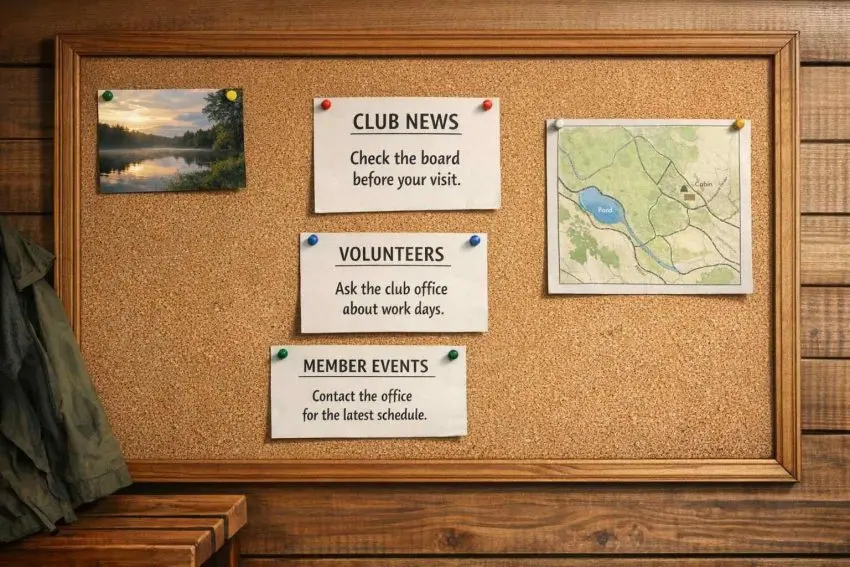
In practical terms a club noticeboard has to earn its place on the wall. If the board is failing to help members make best use of their time during busy seasons then it's causing more problems than it's solving. The root of the problem with most noticeboards is that they get covered in old information which has to be read before members can determine whether or not the information is current or not. If information is added to a notice then it should be possible for members to determine the action they should take as a result of the update.
Start with the symptoms of a failing noticeboard
The symptoms of a failing noticeboard are easy to recognize. At first glance an active board may seem to be delivering the right messages but when members check for information they fail to find what they are looking for. Out of date access information is filed beneath current reminders; a handwritten amendment superseded by a printed version is buried amongst reams of other papers; important messages get lost amongst a mass of other information. Members are forced to ask the same question over and over again.
Some of the less obvious signs of a failing noticeboard include: the lack of a date on a notice; no name of a contact person; ambiguity over whether a notice applies to the whole property or only to a part of it; maps becoming torn and therefore difficult to read; the buildup of several crossed-out notices of different kinds, still all legible but requiring the reader to make sense of them.
It is the organization's problem, not that of its members that they cannot distinguish between up-to-date information and background information. While the board itself is attention-grabbing, the information attached to it should clearly fulfill its intended purpose.
Give every notice a clear job
Before posting a notice decide what action a member should take after reading it. A safety reminder might cause members to pause for a moment and inspect the area before proceeding. A note about a habitat might request that members avoid a particular area while it is being restored and that they report any damage. A meeting notice simply tells members when and where the meeting is to take place. Members can read how you wish them to act from the main message and then read any additional information as required.
Clearly marking the principal message of a notice to inform members of what has happened and enabling them to act on the information published will help to ensure that the information published on the club noticeboard is of use to club members. Determining in advance what information members need to know and how members will react to different types of notice will also help to ensure that club members gain maximum benefit from the information published.
At the top of the page write out the main action required by the note, and then beneath add more details if required. Remember that a noticeboard is for decision at the point of need, therefore information of a background nature must not be posted on a club noticeboard. Such information should be stored in the club's normal method of communication and members directed to that information as required.
Sticking to a simple frame (e.g. all operational notices on the left, habitat- and maintenance-related info in the middle, social info on the right) and applying it consistently should be enough. The different categories should be clear to most club members.
Build a small checking routine
As with any other facility such as gates, paths and other shared equipment, someone needs to carry out the maintenance to ensure that the noticeboard is functioning as it should.
Check for the following. Have any notices expired? Are there any duplicate notices? Are there any notice board pages torn or damaged? Are there any maps that have become blurred or cannot be read? Are there any notices without a name on? Look at the notice board from a member's perspective. Does the information be clearly visible when members arrive late at night or very early in the morning? Is the text large enough to read without having to fold up the notices? Are weathered notices still ok to use?
While leaving corrections on the board as a reminder may seem like the easiest option, they soon get lost amongst other bits and bobs and can be of no use to anyone. Clear them off, either by correcting or throwing them away as needed, and note any outstanding points in the club's normal records.
Keep safety and stewardship messages visible
A number of safety notices, current reserve restrictions, known hazards and current information regarding agreed hunting areas, habitats and places where safe conduct is necessary to prevent harm to members, their guests, their tackle, wildlife and property should be displayed clearly near the top of the Notice Board.
Second, all notices for members regarding habitat and maintenance issues should clearly state the location(s) and the action(s) that need to be taken and who can provide further clarification if needed. For example, a notice could say "Do not enter a certain section of reserve for a few days to allow a newly planted area to establish itself."
However, the club noticeboard does not substitute for current legislation or for relevant regulatory guidance (which can change from time to time). Members should always check for the very latest information on what is permitted by law and/or Club rule to do on club property, and be guided by that information.
Decide what should never be ignored
There are however a few issues that need to be addressed as soon as possible. A new notice that contradicts another safety notice should be resolved immediately. Reports of unverified information regarding access to the reserve, a damaged boundary feature or new signs of damage to habitats should be clearly marked as 'under review' and forwarded to the appropriate club contact.
Try to stop people from casually scrawling on the Notice Board – particularly about changes to the way you go through the gate or the areas where you can hunt. As long as you set up a system for people to put up notices and then for someone to confirm them and then put them up on the board, this should be fine.
Members could be asked to report: information on the noticeboard that seems to be out of date; any change in the environment or circumstances that may affect safe participation by club members; any damage to signs, maps, etc. that are displayed on noticeboards around the shared facilities. A simple description of the problem, where it was found and when it was noticed is all that is required.
The best club organization is not how many notices you can display on a board nor how long a list of do's and don'ts you have. Good organization of a club's communication consists of current information being visible, each update having an owner and a few simple rules being consistently applied. When the season is in full swing, this way of working protects time to do what really matters i.e. allow safe participation of all members, sporting shooting in a respectful manner and proper care of the ground.